








Key Messages
- Fully automated content production generates more volume, but strategically exacerbates the problem of interchangeability (“slop” and “sameness”) rather than differentiation.
- In the “Intelligence Economy,” marketing is shifting to the forefront of advertising: It is crucial to be present in data sources and in the responses from AI systems, since purchasing decisions are often already shaped there.
- AI takes over efficiency and production, but differentiation remains a human trait: Value is created through judgment, genuine ideas, and distinctive brand moments—precisely because automated content floods everything else.
Cannes Lions: Speed Got Cheap
Cannes 2026, day three. In the morning, someone on stage says marketing is soon about to run itself. In the afternoon, the man who runs brand at the world’s largest advertiser says on another stage that robots can’t build brands. Both talks are packed. That contradiction, staged on the same day and mostly left unresolved, is the most honest thing about these Cannes Lions. The hype has not gone away. It has started arguing with itself.
It helps to notice who is on which side. The voices promising that AI changes everything tend to have something to sell you, a platform to rent, a model to meter. The voices saying the basics still hold mostly do not. That is not proof of anything by itself, but it is a good reason to stay skeptical. And the economics back the skeptics this year. OpenAI tripled its revenue to 13 billion dollars last year and spent 34 getting there. As providers move to usage-based pricing, the easy assumption that a machine always beats a person on cost and speed stops being free. My own hunch, and I will flag it as such: the big models are near the flat part of their curve. They are improving only slowly, while the cost of running them continues to rise. Efficiency used to be the promise. Now it has to be proven.
The clearest defense of the fundamentals took half an hour and two men who usually enjoy disagreeing in public. Mark Ritson and Byron Sharp sat down to agree on five things. Mental availability does most of the work. Distinctive assets matter more than almost anything else. Most buyers are out of the market most of the time, so reach beats narrow targeting. Brand purpose is mostly noise. None of it bent because a chatbot arrived. If anything, in a denser content environment, it matters more. An overwhelmed brain does what it always has. It reduces complexity and reaches for the brand name it already knows.
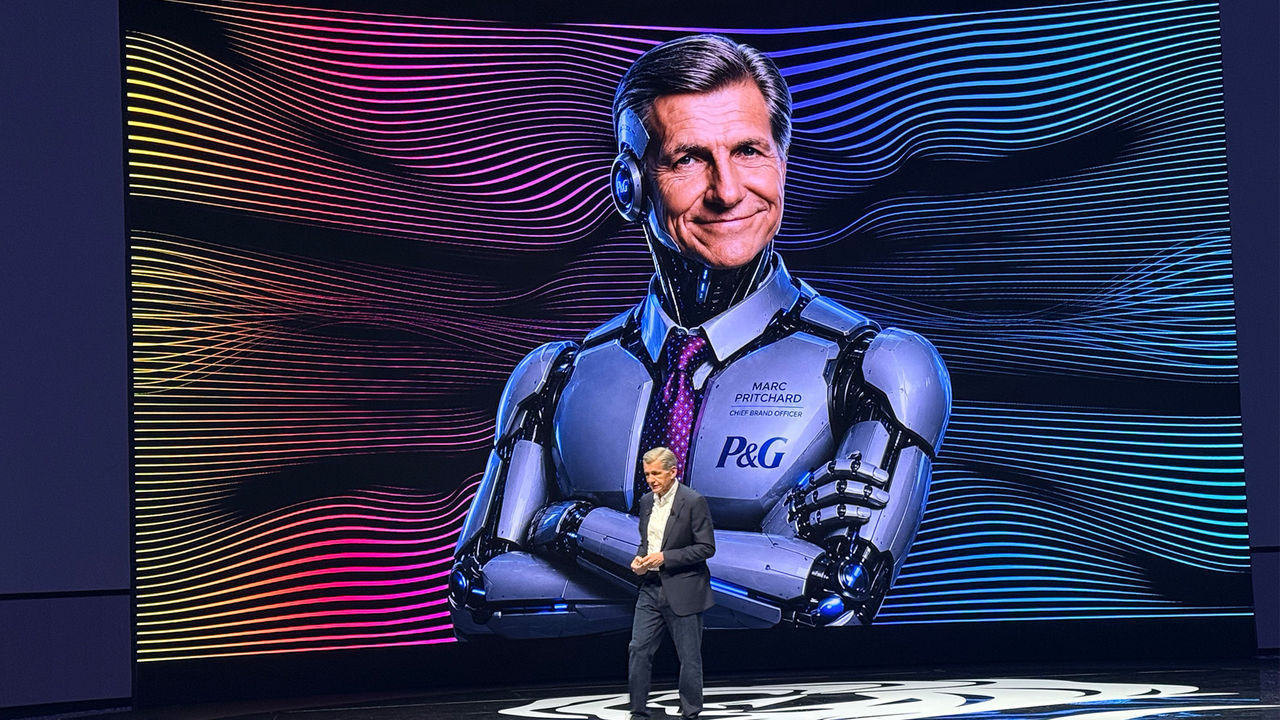
Marc Pritchard made the same case from the buyer's seat, which is why it carried. P&G is the biggest advertiser on earth, and its brand chief called his session "Robots Can't Build Brands" without a trace of nostalgia. The company uses AI everywhere, to research, to brainstorm, to test, and now ships finished work in a fraction of the old time and at significantly lower cost. But the idea still starts with a person. Behind the P&G brand Secret is the insight that you are the last to notice your own stress sweat. Behind Fairy is the very British habit of letting dirty dishes soak first. The machine made production faster. It did not have the thought.
Which is where the most attention-grabbing announcement of the week starts to look complicated. Meta showed a system that writes the creative, builds the asset, picks the format and buys the media on its own, in real time. Remarkable engineering, and a much harder logic to defend. The problem on the consumer side is that people are already drowning in content. And the proposed solution is more of it, faster and cheaper, from everyone at once. The cure is the disease. We already have a word for an internet flooded with cheap, automatically generated content. Most people just call it slop.
It also fuels exactly the issue we have been working on since the SXSW conference in March 2026 and discussing with companies all year: sameness. When everyone reaches for the same tools and optimizes toward the same middle, the middle vanishes. And a recommendation engine has no reason to surface a brand that sounds like the rest. An automated system trained on the average reliably produces more average. You do not industrialize your way out of interchangeability.
OpenAI aimed higher. We are leaving the attention economy for an intelligence economy, they say, and it is finally time for marketing to become useful. That word stood out. Useful. As if marketing had not been creating impact for decades. The simpler explanation sits on the balance sheet. OpenAI is spending heavily and needs the advertising income, and about a fifth of ChatGPT conversations already carry commercial intent. As more people hand their product research to a chatbot, the journey shortens, and the decision is often half made before a brand even has a chance to speak.
The more important lever sits one step earlier. If the chatbot becomes the point of sale, what matters is being among the brands the answer gets built from in the first place. These systems read everything, the channels you own and especially the ones you do not: the reviews, the forums, the press, the people who talk about you. A consistent brand story across all of them becomes the price of being mentioned at all. And Google has no intention of leaving that space to OpenAI. Google’s own CMO sat on the same panel. So, the discovery fight is wide open. That alone is the best reason I know to keep a foot in more than one camp.
After all, the session I enjoyed most pointed the opposite way, and it might have been the most strategic of all. A lot of the work winning awards in Cannes this year is visibly made by hand, real and imperfect, and the juries keep pointing that out, almost with relief. Polaroid's Creative Director Patricia Varella built a whole talk around the same instinct. People are tired of everything being pixel-perfect. Imperfection is turning into a luxury. The physical world remains the only place where a person encounters a brand without a machine in between. And as the feeds fill up with automated content, those unfiltered moments become rarer and more valuable.
So, three days in. This week was never really about whether AI is good or bad. Automation took over the cheaper half of the job: speed, volume, production. It left the more expensive half exactly where it was: judgment, the distinctive idea, the person who notices something true. Then, by flooding everything around it, it made that half even scarcer. The brands reading this week as a call to automate everything are pouring budget into the part that just got cheaper. The ones still standing next year will be the ones investing in what is not.
This article was first published in Horizont.
Alexander Turtschan
About the author
Alexander develops innovative products and solutions for his clients’ communication strategies. With a passion for digital media, he focuses on pop culture, communication, and storytelling, particularly as they relate to Gen Z and Gen Alpha. He began his career in digital market and advertising impact research; after graduating from LMU Munich, he worked at SevenOne Media and Plan.Net. From 2018 to 2022, he led an in-house consulting unit as Director of the Digital Accelerator at Mediaplus. Alex is a founding member of the BVDW’s Future Innovation & Technology Expert Group and a guest lecturer at Miami Ad School Europe, IU, and HS Fresenius.
This could also be of interest to you:


About Mediaplus
Mediaplus is one of the largest independent media agencies in Europe and part of the Serviceplan Group — an integrated communications network headquartered in Munich. Founded in 1983, the agency group today brings together around 2,200 specialists across more than 20 wholly owned offices in Europe as well as markets in Asia, the Middle East, and North America. Through partner locations, Mediaplus maintains a presence at 42 sites worldwide. Its service portfolio spans Media Strategy & Innovation, Media Planning & Buying, Data & AI, Performance Marketing, Advertising Technologies, and Commerce & Retail Media. Through its group-wide AI framework House of AI, Mediaplus combines proprietary data models with deep market expertise to deliver measurable brand growth for its clients. Mediaplus has repeatedly been ranked among the leading independent media agencies in both the WARC Media 100 and the RECMA Quality Ranking, and was named Media Agency of the Year at the German Media Awards for the fifth time in 2026.