



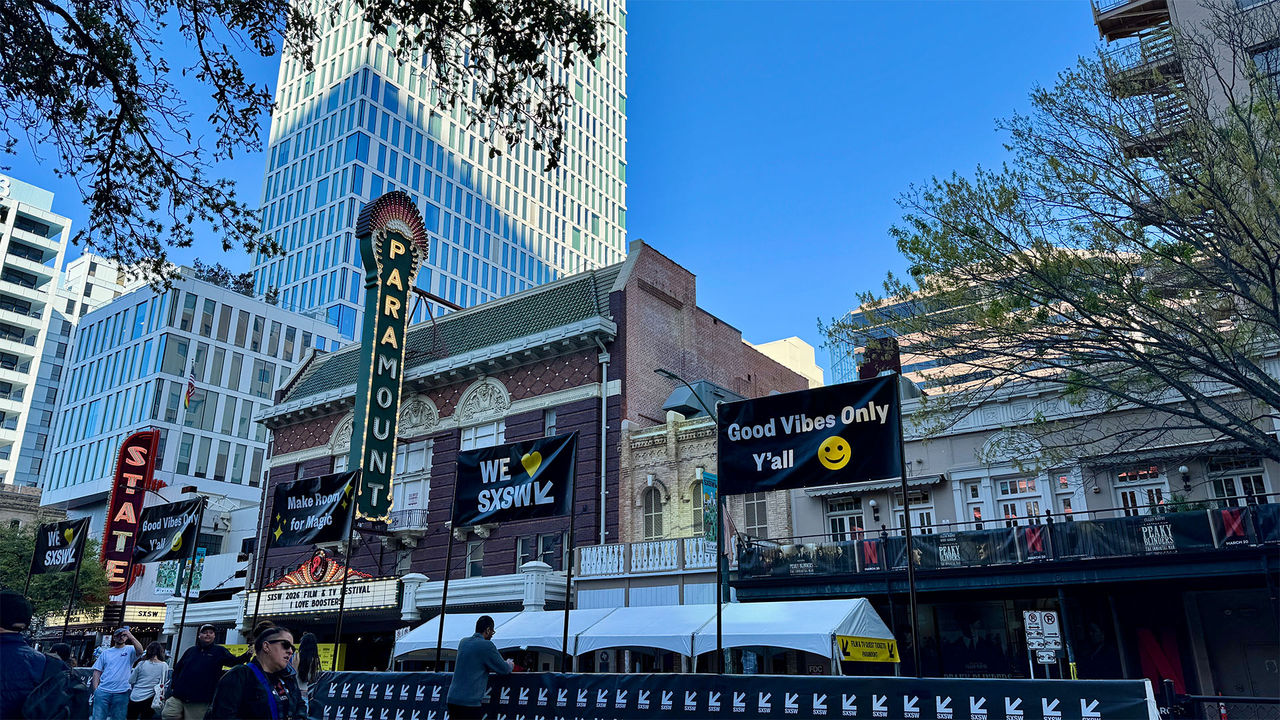


SXSW has always been an excellent seismograph for the topics shaping marketing, entertainment, and business as a whole. For a long time, the Austin Convention Center with its very specific 90s charm was the beating heart of the conference. This time around, it's gone. Demolished. SXSW 2026 is happening without its center of gravity, spread across hotel ballrooms all over downtown. This is my ninth SXSW, and for the first time ever I found myself rethinking how to move through the conference.
This exact feeling turned out to be a fitting backdrop. Journalist and bestselling author Jennifer B. Wallace opened the conference not with a technology prediction, but with a question about human behavior. We're in the middle of one of the biggest innovation waves in history, she noted, and our collective response is to reach for the past. Vinyl sales soaring. People driving hours to visit restaurants redesigned to look exactly like the 1990s. Her read: we're not nostalgic for the objects. We're nostalgic for how we felt. For the belonging that used to be baked into everyday life.
That observation has carried through the first three days of SXSW 2026. Many sessions, from very different angles, arrived at a similar place: the disruption AI is causing in business gets all the attention. The disruption it's causing in the lives of the people, of consumers, barely gets discussed.
The end of the trend report
Saturday morning. Futurist Amy Webb took the stage to launch her signature Emerging Tech Trend Report, as she has at every SXSW for the past 15 years. Or so we thought. Instead, she opened with a eulogy. The report is dead, she announced, because isolated trends can no longer explain a world where everything is colliding at once. Her replacement framework: convergences. System-level shifts created when multiple trends interact – such as human augmentation, unlimited labor, emotional outsourcing.
The first two paint the structural picture. Every economy, every wage system, every social contract was built on the assumption that people drive productivity. AI and robotics are dismantling that assumption. And while we spend most of our energy discussing AI's impact on business and the economy, her third convergence pointed somewhere we barely talk about: what AI is doing to people's emotional and social lives.
Emotional outsourcing
Webb defined it as the shift of comfort, validation, and companionship to machines. The progression is structural. Substitution becomes dependency becomes infrastructure. The emotional load shifts from humans to systems. Emotional AI becomes invisible, assumed, essential. And whoever controls that infrastructure controls the upstream of how people feel before they think, vote, buy, or trust.
The business logic, as Webb framed it, was blunt. First make people lonely, then sell them connection. First automate their jobs, then sell them purpose.


The consumer is being rewired
Webb painted the system. Other sessions filled in the people. For example, Kasley Killam, a Harvard-trained social scientist whose work established social health as a third dimension of wellbeing alongside physical and mental health, presented data on where that dimension is heading. Families eating meals together dropped from 84% for older generations to 38% for Gen Z. "How to make friends" is at peak search volume globally. According to Killam, 49% of Gen Z have already built a meaningful relationship with AI, 37% can see themselves falling in love with an AI companion. That alone should give us pause.
People are outsourcing emotional needs to machines at the exact moment their real-world social infrastructure is thinning out. This is Webb's emotional outsourcing convergence at street level. Social health, Killam argued, is following the same trajectory mental health did a decade ago. Except faster, because technology is actively reshaping the conditions.
Adam Aleksic, known online as Etymology Nerd, a linguist and content creator, added another layer to this development. AI language models, trained primarily on academic and formal text, systematically overrepresent certain types of vocabulary. Quirky on its own. But the mechanism behind is not: humans absorb AI language patterns without noticing, and since 2023, the use of AI-favored vocabulary in human writing has been measurably increasing. In other words: we are being linguistically reshaped by machines we think we're just using as tools.
But Aleksic’s argument went even further: Social media algorithms don't just amplify culture, they manufacture it. Spotify, for example, coined the genre "hyperpop" after its algorithm identified a cluster of listeners. The label created the movement, not the other way around. The same mechanism drives tradwife aesthetics, Labubu collectibles, Dubai chocolate trends, and countless viral phenomena that feel organic but are, in reality, algorithmic artifacts.
On a related note: Rohit Bhargava, founder of the Non-Obvious Company and an SXSW regular for 17 years, used the stage to announce his next book, Future Words – a collection of terms capturing the spirit of our time, naming modern situations that don’t yet have a word but probably should. At a conference where Aleksic showed how AI and algorithms are increasingly generating vocabulary for things that don't emerge organically, the idea of deliberately naming what actually does feels like the right kind of counterweight.
What this leaves us with: The other side of the data
If Webb, Killam, and Aleksic mapped the systemic shifts, other speakers grounded things in something less quantifiable. Natalia Davila, Chief Strategy Officer at Gut agency, made a case rooted in her work with top brands: love, in all its messy and irrational forms, still drives more consumer decisions than any journey map. No revelation, but very fitting at a conference so obsessed with AI that it turned out to be surprisingly human.
These were only the first three days, but a pattern has already emerged across sessions ranging from futurism to linguistics to the state of modern love: A growing share of consumers are forming their closest bonds with machines. The language they use is being quietly reshaped by the tools they interact with. The culture they think they're discovering organically may have been assembled by an algorithm and, increasingly, monetized by people betting on their attention. None of this makes traditional marketing thinking obsolete. But it raises the question of whether we're building strategies for a consumer who is already becoming someone else.
In the end, it was Hollywood star Jamie Lee Curtis who came closest to a strategic brief. Paraphrasing Maya Angelou, knowingly or not: "When you die, nobody cares how much money you had in the bank or how successful your business was. What people remember is who you were as a person, how you treated others and how you made them feel."
Not the worst brief to take home from Austin.
This article first appeared exclusively at Campaign Germany.